 grozdan44
Garni Temple & Geghard Monastery from Yerevan — Complete Guide 2026
Armenia’s most visited day trip. What it looks like, how long it takes, which tour is worth it.
Garni and Geghard sit 30 kilometres east of Yerevan in the Azat river gorge and between them cover almost everything that makes Armenia surprising: a perfectly preserved Hellenistic temple from the 1st century AD on a basalt cliff above a river canyon, a medieval monastery that is literally carved into the rock face of the gorge, and between them a geological formation — the Symphony of Stones — that most people do not realise is there until they are standing in front of it. This guide is how to do both properly.
Planning a trip to Garni & Geghard?
Both sites are 30–35 km from Yerevan. A private tour covers both plus the Symphony of Stones in 6–8 hours and is the most practical option — public transport to Geghard does not exist and marshrutka to Garni is infrequent. Book ahead: private tours to the gorge sell out in spring and autumn.
Quick Answer — Can you visit Garni and Geghard in one day?
Yes, easily. The two sites are 12 km apart and most tours combine them in a half or full day from Yerevan. A half-day (4–5 hours) covers both with reasonable time at each; a full day (7–8 hours) adds Khor Virap or the Symphony of Stones walk and feels less rushed. Garni Temple takes 45–60 minutes; Geghard Monastery takes 60–90 minutes. Add 20 minutes for the Symphony of Stones if your driver stops (they should).
What’s in this guide
Garni Temple — What You Are Actually Looking At
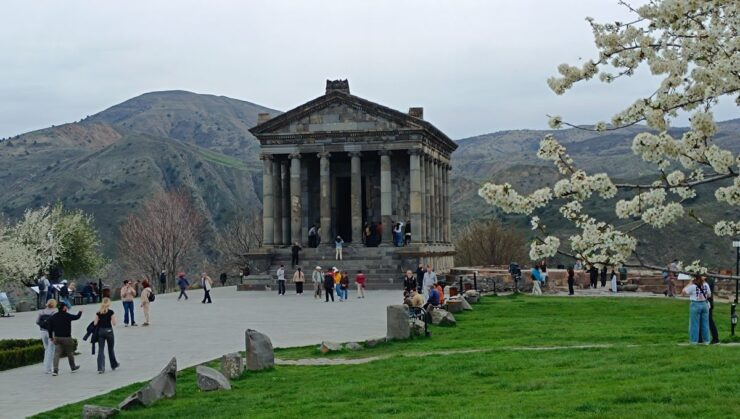
Garni is the only standing Hellenistic-style temple in the entire former Soviet Union and one of very few outside Greece and Rome. That sounds like a tourism board line but it is simply accurate: when you turn the corner into the temple complex and see the colonnade rising above the basalt cliffs of the Azat gorge, it does not look like what you expected to find in Armenia.
The temple was built in the 1st century AD by the Armenian king Tiridates I, likely as a dedication to the sun god Mihr (the Armenian equivalent of Mithras). It is Ionic order, with 24 basalt columns on a stepped podium above a sheer drop into the Azat river canyon. After Armenia adopted Christianity in 301 AD, the temple was converted to a royal bathhouse, which is probably why it was not demolished — it became useful rather than heretical.
The structure you see today is a 1970s reconstruction. An earthquake in 1679 collapsed the original, and Soviet archaeologists rebuilt it using the surviving stones between 1969 and 1975. The reconstruction is good. It is worth knowing this because occasionally it matters to people, and you should know before you arrive rather than have someone tell you at the gate.
The complex includes a small church of Saint Sion (7th century, significantly less impressive than Geghard but worth a quick look), a royal palace, and a bathhouse with a good surviving mosaic floor depicting sea gods and mythological figures. The bathhouse interior is included in the entry ticket — do not skip it, most visitors do and it is better than the exterior suggests.
Entry: AMD 1,500 ($3.85). Opening hours: 11:00–17:00 Monday/Tuesday; 09:00–19:00 Wednesday–Sunday (check for seasonal changes). The car park has vendors selling pomegranate juice, churchkhela and dried fruit — the pomegranate juice is good; the souvenir stalls are what they are.
Don’t bother with this
The gavar (region) around Garni village has several cafes with terraces advertised as having gorge views — most are overcrowded in summer, mediocre quality, and the views are blocked by cars. Bring a picnic or eat in Yerevan before or after.
The Symphony of Stones — the Part People Miss
Between Garni and Geghard, the road runs along the Azat river gorge. If your driver knows what he is doing (or if you ask), he will stop at a point where the gorge narrows and the far wall consists of perfectly hexagonal basalt columns rising 50 metres from the river. These are the Symphony of Stones — a geological formation created by slowly cooling lava approximately 14,000 years ago.
The columns are irregular pentagons and hexagons, tightly packed, some tilting, some perfectly vertical. They look like an organ pipe installation at a scale that does not make immediate sense. The walk down to the riverbank takes about 15 minutes on a rough path and is worth it for the view looking back up at the columns from below.
The walk down requires reasonable footwear — not hiking boots, but not sandals. There is no entry fee. Allow 30–45 minutes including the descent and ascent.
Geghard Monastery — Inside the Rock
Geghard (Գեղարդ — meaning “the Spear”) is a medieval monastery complex that begins as a conventional Armenian stone church and then, improbably, continues underground — carved directly into the cliff face of the gorge. Two of the main churches are entirely hewn from the living rock. Stalactites hang from the ceilings of the cave chambers. Spring water seeps through the walls of the sacristy. The light, on a good day, falls through small apertures in the carved rock and makes shapes on the floor.
It was founded in the 4th century, substantially expanded by the Zakarian princes in the 12th and 13th centuries, and the cave churches were carved during that same period. The name refers to the Holy Lance — the spear said to have been used at the Crucifixion — which was kept here for centuries. The monastery was added to UNESCO’s World Heritage List in 2000 as part of the Monastery of Geghard and the Upper Azat Valley.
Entry is free. Modest dress is required — shoulders and knees covered. The monastery runs services; Sunday mornings are atmospheric but crowded. Arrive before 10am for the best experience in any season. The complex is about 15 minutes walk from the car park through a gorge path lined with vendors selling lavash, honey, dried fruit and handicrafts — the lavash here is good (watch it being made), the handicrafts are of varying quality.
Practical tip
Geghard gets very crowded with tour buses between 11am and 2pm. The ideal timing is arriving by 9:30–10:00am, before the first buses. If you arrive at noon it is still worth it, but the cave churches will be full and the experience is different.
Which Tour to Book — Honest Comparison
Getting to Geghard without a car or tour is genuinely difficult — there is no direct public transport from Yerevan to the monastery. Garni has an infrequent marshrutka service (minibus 284 from Yerevan’s Gai bus station, about AMD 300/$0.75 — but it only goes to Garni village, not to Geghard). For most visitors, a tour or rented car is the practical choice.
Best for: Private, flexible
Private 7–8hr: Khor Virap, Garni, Geghard
Full day with a private driver/guide. Covers Khor Virap monastery (with Ararat views), Garni Temple, Symphony of Stones, and Geghard. Flexible timing — you stop when you want. Best option for 2–4 people.
From ~$45–65 per person
Best for: Half day, private
Private Half-Day: Garni & Geghard only
Focused 4–5 hour private tour direct to Garni and Geghard without the Khor Virap detour. Good if you have already seen Khor Virap or want a tighter schedule. Morning departure recommended.
From ~$30–45 per person
Best for: Budget, social
Group Tour: Garni, Symphony, Geghard + Lavash Baking
Small group tour with the addition of a lavash baking experience — you make the traditional flatbread on a tonir clay oven. Cheaper per person than private; good for solo travellers. Watch the group size before booking.
From ~$25–35 per person
Best for: Sunset / photography
Evening Tour: Khor Virap, Azat, Garni & Stones
Afternoon/evening departure — catches Khor Virap in golden light with Ararat, then Garni at dusk. Different atmosphere from a morning tour; Geghard is quieter in the late afternoon. Suits photographers.
From ~$30–50 per person
Best for: Self drive
Rent a Car — Localrent Armenia
If you want total flexibility — your own timing, stops when you want — a rental car is the best way to do the Garni-Geghard circuit. The road from Yerevan is fully paved. No 4WD needed. About AMD 15,000–20,000 ($38–51) per day for a basic car.
From ~$38/day
Avoid the taxi touts at Yerevan’s Republic Square
Unofficial drivers hanging around Republic Square offering “private tours” to Garni and Geghard charge more than organised tours and provide no recourse if the car breaks down or the driver decides to skip the Symphony of Stones. Book through Viator, GetYourGuide or Localrent where there is accountability.
How to Spend the Day — Suggested Order
The standard order is Garni first, then Symphony of Stones, then Geghard. This makes geographic sense (you go progressively further into the gorge) and timing sense (Geghard is quieter in the afternoon than the morning if you arrive before the second wave of tour buses around 2pm).
9:00–9:30am — Depart Yerevan
Leave early from Yerevan
The drive to Garni takes 40–50 minutes from central Yerevan depending on traffic. Leaving by 9am gets you to Garni around 9:45–10:00 — before most tour buses. The road through the gorge on the way out is good enough to be worth looking at rather than sleeping through.
10:00–11:15am — Garni Temple
Garni Temple (75 minutes)
Temple exterior and colonnade (20 min), then the bathhouse mosaic floor (15 min), then Saint Sion church (10 min), then walk to the gorge viewpoint above the temple (15 min). Buy pomegranate juice from the vendor by the gate on the way out. Do not buy lunch here.
11:30am–12:15pm — Symphony of Stones
Symphony of Stones (45 minutes)
12 km drive from Garni. Ask your driver to stop — the pull-in is not obvious. Walk down to the river bank (15 minutes on a rough path). Look back up at the columns from the river level. The downward view from the path is good; the upward view from the river is better. Allow time for both.
12:30–2:00pm — Geghard Monastery
Geghard Monastery (90 minutes)
Main church first, then through the low doorway into the first cave church, then the second cave church further in. Allow eyes to adjust each time — the carved detail becomes visible slowly. If there is a choir or service, stay longer. The path back to the car park through the vendor stalls: the lavash is worth buying.
2:30–4:00pm — Return or extend
Return to Yerevan or add Khor Virap
Direct return to Yerevan takes 50–60 minutes. Alternatively, if you have a private driver, add Khor Virap monastery on the return — it is 30 km south of Yerevan, 40 minutes from Geghard. Khor Virap has the closest accessible view of Mount Ararat in Armenia. Best in late afternoon light.
Getting There from Yerevan
There are four practical options depending on your budget and flexibility.
| Option | Cost | Covers Geghard? | Flexibility |
|---|---|---|---|
| Organised tour (private) | $30–65/person | Yes | High |
| Organised tour (group) | $20–35/person | Yes | Low |
| Rental car | $38–55/day | Yes | Total |
| Marshrutka + taxi | ~$5–10/person | Taxi from Garni only | Very low |
By marshrutka (budget option): Bus 284 from Gai bus station in Yerevan to Garni village costs AMD 300 ($0.75) and runs roughly hourly. From Garni village to Geghard you need to either walk (7 km, uphill) or negotiate a local taxi from the car park (AMD 2,000–3,000/$5–7.70 one way). This works but requires patience — last marshrutka back to Yerevan leaves Garni around 6pm.
Getting a SIM for navigation
If you are driving yourself, get an Armenian SIM or eSIM before heading out — offline maps are fine for the main road but the Geghard turn-off is unmarked and you will want live GPS. Airalo Armenia eSIM is the easiest option to set up before you land.
Getting to Yerevan: Fly into Zvartnots International Airport (EVN). The airport is 12 km from the city centre. Kiwitaxi offers fixed-price transfers — AMD 6,000–8,000 ($15–21) to central Yerevan.
Best Time to Visit Garni & Geghard
Both sites are open year-round. The gorge is most beautiful in spring (April–May, when the hills above are green and the trees in the gorge are in flower) and autumn (September–October, when the colours turn). Summer (July–August) is crowded and can be hot in the gorge; the sites are still worth it but go early. Winter visits are possible and often surprisingly atmospheric — Geghard with light snow on the carved rock is something.
The one season to plan around: Armenian Orthodox Easter (date varies, late April or May). The region around Garni and Geghard fills with families on excursions and the roads are crowded. Not a reason not to go, but worth knowing.
Where to Stay in Yerevan
There is no reason to stay near Garni or Geghard — Yerevan is the right base, 40–50 minutes away and a city worth spending 2–3 nights in regardless. These are the Yerevan hotels I would actually recommend across different budgets.
5-Star Luxury — Best in Yerevan
The Alexander, a Luxury Collection Hotel
Marriott’s Luxury Collection property in Yerevan — central location, excellent service, rooftop bar with Ararat views on clear days. The best address in the city if budget is not the constraint.
5-Star — Central, Iconic
Armenia Marriott Hotel Yerevan
The Soviet-era grand hotel on Republic Square, extensively renovated. The location is the best in the city — everything is walkable. The rooftop pool is an unexpected bonus.
Spa & Wellness
Grand Hotel Yerevan — Small Luxury Hotels
Part of the Small Luxury Hotels of the World collection. Spa, pool, genuinely good restaurant. A quieter, more intimate option than the Marriott properties with better food.
Mountain Views
Nork Residence Hotel
On the Nork plateau above the city — the mountain views including Ararat are among the best in Yerevan. Slightly outside the city centre (10 minutes by taxi) but the views justify it.
Family Friendly
Opera Suite Hotel
Good central location near the Opera House, family rooms available, reliable mid-range option with spacious suites. Well-reviewed for families and longer stays.
Boutique / Eco
Tufenkian Historic Yerevan Hotel
Part of the Tufenkian Heritage group — Armenian-owned boutique hotels with strong character. This one is in a restored historic building with good Armenian food downstairs. The most locally rooted option on this list.
More Armenia & Caucasus Guides
- Armenia Travel Guide 2026 — complete country overview
- Yerevan Travel Guide 2026 — what to do in the capital
- Lake Sevan Guide — Armenia’s blue lake, 1 hour from Yerevan
- Tatev Monastery Guide — the Wings of Tatev cable car, Syunik
- Debed Canyon — Haghpat & Sanahin — UNESCO monasteries in the north
- Is Armenia Safe? 2026 — honest safety guide
- Armenia Travel Costs 2026 — real budget breakdown
- Best Time to Visit Armenia — month by month
- Getting from Tbilisi to Yerevan — overland crossing guide
- Georgia Travel Guide 2026 — the neighbouring country worth combining
Frequently Asked Questions
How far is Garni Temple from Yerevan?
Garni is 28 km from central Yerevan — about 40–50 minutes by car. Geghard Monastery is 12 km further along the gorge, around 50–60 minutes from Yerevan total.
Is there an entry fee for Geghard Monastery?
No. Geghard Monastery is free to enter. Garni Temple charges AMD 1,500 ($3.85) per person for the main complex including the bathhouse mosaic. Parking at both sites is AMD 200–300 ($0.50–0.75).
Can you get to Geghard by public transport?
Not directly. Marshrutka 284 from Yerevan’s Gai bus station goes to Garni village (AMD 300/$0.75, roughly hourly). From Garni to Geghard there is no public transport — you need to take a local taxi (AMD 2,000–3,000/$5–7.70 one way) or walk the 7 km. Most visitors take an organised tour or rent a car.
How long do you need at Garni and Geghard?
Garni Temple: 45–75 minutes. Symphony of Stones: 30–45 minutes. Geghard Monastery: 60–90 minutes. Total with driving: a half day (4–5 hours) is enough for both; a full day (7–8 hours) is more relaxed and allows adding Khor Virap.
What is the Symphony of Stones?
A natural geological formation of hexagonal basalt columns in the Azat river gorge between Garni and Geghard. The columns formed from slowly cooling lava approximately 14,000 years ago. They rise 50 metres from the riverbank and are often missed by visitors who do not ask their driver to stop. Entry is free; allow 30–45 minutes.
What should I wear to Geghard Monastery?
Modest dress is required — shoulders and knees covered. Women are asked to cover their heads inside the main church (scarves are available at the entrance). The cave churches are cool and slightly damp regardless of season — bring a layer.
Is the Garni Temple a reconstruction?
Yes. The original 1st-century AD temple collapsed in a 1679 earthquake. Soviet archaeologists rebuilt it between 1969 and 1975 using the surviving stones. The reconstruction is considered accurate and high quality. The original plan, column drums and architectural details were largely preserved and used in the rebuild.
Ready to Book Your Garni & Geghard Trip?
Private tours sell out in spring and autumn — book at least a few days ahead.
This article contains affiliate links. If you book through them, CaucasusExpert.com earns a small commission at no extra cost to you. All recommendations are based on personal experience and honest assessment. Full disclosure policy.