 grozdan44
Driving in Armenia 2026 — Is It Safe? Complete Guide
Honest answers. Road conditions, Armenian driving culture, which roads to avoid, and how to rent a car properly.
Armenia rewards drivers. The country is compact, most headline destinations are connected by fully paved roads, fuel is cheap by Western standards, and a car gives you freedom that tours and marshrutka simply cannot — to stop at Noravank when the light is right, to arrive at Khor Virap at dawn before anyone else, to spend an extra hour at Haghartsin because you feel like it. The honest caveat: Armenian driving culture requires attention, some mountain roads demand respect, and there is one zone you simply do not drive near. This guide covers everything you need to know.
Quick Answer — Is it safe to drive in Armenia?
Yes, for the vast majority of routes. The main highways connecting Yerevan to Sevan, Dilijan, Gyumri, Vanadzor and the south are fully paved and well-signed. The risks are real but manageable: Armenian drivers are assertive and lane discipline is loose, mountain roads require care especially in wet conditions, and some rural roads are rough. The Azerbaijan border zone is the one absolute no-go. With appropriate attention, renting a car in Armenia is one of the best decisions a visitor can make.
Quick Answer — Is it safe to drive in Armenia?
Yes. Driving in Armenia is safe on main routes with appropriate care. The M1 (Yerevan–Gyumri), M4 (Yerevan–Sevan–Dilijan) and M2 (Yerevan south towards Khor Virap and Noravank) are all paved and well-maintained. Mountain roads require more attention — narrow, sometimes unpaved, with steep drops. Armenian driving style is assertive by Western standards but traffic volumes outside Yerevan are low. The main hazard is inattentive driving rather than road quality on the main routes.
What’s in this guide
Road Conditions for Driving in Armenia
M1 — Yerevan to Gyumri
Good — 85/100Dual carriageway for most of the route, 128 km. Well-maintained, fast. The main connection between Armenia’s two largest cities. Petrol stations throughout.
M4 — Yerevan to Dilijan via Sevan
Very good — 88/100Modern motorway standard to Sevan, then good road to Dilijan. The best-maintained road in the country. No issues for any standard car.
M2 South — Yerevan to Khor Virap & Areni
Good — 82/100Fully paved to Noravank and Areni. Good condition throughout. Petrol available at Artashat. Standard car fine.
Road to Tatev (via Goris)
Good — 75/100Fully paved all the way to Goris and Tatev via Halidzor. Some winding mountain sections but manageable in a standard car. Allow extra time.
Debed Canyon — Alaverdi to Haghpat
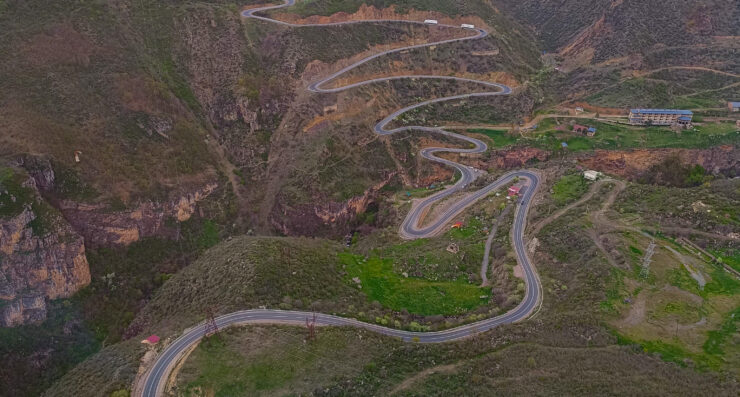
Moderate — 65/100Paved but narrow in sections, some potholes. Manageable in standard car. The canyon road itself is stunning but requires attention.
Svaneti-equivalent — remote areas
Variable — 45/100Zangezur mountains, remote Tavush, Gegham highlands: unpaved, rough, sometimes with steep drops. 4WD strongly recommended. Check conditions before attempting.
Armenian Driving Culture — What to Actually Expect
This is the section that other guides skip because it requires saying something unflattering. Armenian driving is assertive, sometimes unpredictable, and operates on a set of informal conventions that differ from Western European or North American norms. Understanding this before you get in the car is more useful than finding out mid-roundabout.
What you will encounter
Lane discipline is loose. Lanes are treated as approximate guidelines, particularly in Yerevan. Drivers change lanes without signalling, sit across lane markings, and create informal lanes where none are painted. Stay alert at all times in the city.
Overtaking on mountain roads happens. On two-lane mountain roads, Armenian drivers will overtake on bends, on inclines, in conditions where Western drivers would not. Pull over slightly when a car approaches in the opposite lane — the road is often narrower than it looks and the other driver may be overtaking.
Junctions are negotiated, not yielded. The theoretical right-of-way rule is understood by all and followed by some. In practice, larger vehicles and more confident drivers tend to proceed. At unmarked junctions, slow down and make eye contact.
Pedestrians step out. In Yerevan especially, pedestrians cross wherever convenient and will step off the pavement without checking for traffic. Drive slowly in residential streets and near markets.
Practical advice
Drive defensively, not aggressively. Yield generously and let assertive drivers pass you — the time cost is seconds. Outside Yerevan, traffic volumes are very low and the driving culture is significantly more relaxed. The city is the hardest part.
Driving Rules in Armenia
| Rule | Armenia regulation | Notes |
|---|---|---|
| Drive on | Right side | Same as most of Europe and USA |
| Speed limit — city | 60 km/h | Enforced by speed cameras in Yerevan |
| Speed limit — highway | 90 km/h | 110 km/h on some motorway sections |
| Drink driving limit | 0.00% BAC | Zero tolerance — strictly enforced |
| Seatbelts | Mandatory front seats | Rear seatbelts required if fitted |
| Mobile phones | Hands-free only | Fines enforced |
| Headlights | Required at all times | Daytime running lights mandatory |
| Child seats | Required under 12 | Confirm availability when renting |
| Minimum driving age | 18 | Rental companies often require 21+ |
Zero alcohol — strictly enforced
Armenia has a 0.00% blood alcohol limit — not 0.05% like many European countries, but zero. Traffic police checkpoints exist and breathalysers are used. If you plan to taste wine in Areni or brandy in Yerevan, do not drive that day. The fine for drink driving is substantial and the legal process unpleasant.
Roads & Areas to Avoid
The Azerbaijan border zone — absolute no-go
This is the most important safety information in this guide. The border area between Armenia and Azerbaijan is not clearly demarcated in several sections, remains the subject of ongoing military tension, and has seen armed incidents as recently as 2023. Do not drive near the Azerbaijani border. This applies to the eastern sections of Gegharkunik region and parts of Syunik near the new border line.
The main tourist routes — Yerevan to Sevan, Dilijan, Tatev, Khor Virap, Noravank, Haghpat — are all well within safe Armenian-controlled territory. The concern is with border-adjacent areas that have no tourist interest anyway.
Check current advisories
The border situation with Azerbaijan can change. Check the UK FCDO and US State Department travel advisories within two weeks of travel. The main tourist routes are consistently listed as safe; the specific border areas are listed as avoid.
Other roads requiring caution
Winter mountain roads: The Selim Pass (connecting Vayots Dzor to Gegharkunik) can be closed in heavy snow. The road to Tatev can be icy December–February. Check road conditions before heading into the mountains in winter — your rental company or guesthouse will have current information.
Night driving on mountain roads: Many mountain roads have no lighting and significant drops with minimal barriers. Driving mountain routes at night is not recommended unless you know the road well. Plan itineraries to arrive before dark.
Flooded roads in spring: April–May snowmelt can cause temporary flooding on lower valley roads and river crossings. Roads are generally clear within 24–48 hours but check conditions after heavy rainfall.
Best Scenic Drives in Armenia
A rental car unlocks the best version of Armenia. These are the drives worth planning around:
★ Best day drive
Southern Armenia Loop
Yerevan → Khor Virap → Noravank → Areni → Yerevan · ~280 km · 1 dayThe classic. Khor Virap at dawn with Ararat, Noravank red canyon in the afternoon, wine tasting at Areni on the way back. All paved roads, easy navigation, extraordinary scenery.
★ Best 2-day drive
Southern Armenia to Tatev
Yerevan → Khor Virap → Noravank → Goris → Tatev → Yerevan · ~520 km · 2 daysDay one south to Goris, day two Tatev cable car and Khndzoresk cave village. The road through the Vorotan gorge before Tatev is one of the most dramatic drives in the Caucasus.
Best north drive
Northern Armenia Circuit
Yerevan → Sevan → Dilijan → Haghpat → Sanahin → Yerevan · ~350 km · 1–2 daysLake Sevan, Dilijan forest and monasteries, Debed Canyon UNESCO sites. In October the autumn colour along this route is exceptional.
Best road trip
Full Armenia Loop
Yerevan → south → Tatev → Goris → Debed Canyon → Dilijan → Sevan → Yerevan · ~700 km · 4–5 daysThe complete Armenia road trip. Covers every major region, both UNESCO monastery clusters, the best canyon scenery and lake. The right format for visitors with a week and a love of driving.
Planning a multi-day Armenia road trip?
Base yourself overnight in Goris (for Tatev), Alaverdi (for Debed Canyon), or Dilijan (for the north). Book ahead — these fill quickly in July and October.
Renting a Car for Your Armenia Road Trip
Car rental in Armenia is straightforward with a few specifics worth knowing. Prices are lower than Western Europe; road infrastructure on main routes is good; and the freedom gained is significant.
Which car type do you need?
Standard/compact car: Fine for all main routes — Yerevan, Sevan, Dilijan, Khor Virap, Noravank, Tatev (via Goris), Debed Canyon. The vast majority of visitor itineraries require nothing more.
SUV/4WD: Required if you plan remote mountain driving — Zangezur highlands, the Gegham mountains, off-road routes in Dilijan National Park, or winter mountain driving where roads may be icy or snowy.
★ Best comparison platform
Discover Cars
Aggregates local and international rental companies in Armenia. Best for comparing prices across multiple providers. Often finds deals that direct booking misses.
Best local rates
Localrent Armenia
Local Armenian car owners renting directly — typically cheaper than international chains, with local knowledge of road conditions. Good option for flexible pick-up locations.
International brands
AutoEurope
International platform with major brand options (Hertz, Europcar, Sixt) available in Armenia. Better for those who want familiar brands and standardised service agreements.
Budget option
EconomyBookings
Focus on budget-friendly rentals. Good for finding the cheapest daily rates in Armenia if flexibility on car model is acceptable.
Cross-border policy
Most Armenian rental companies do not allow their cars to be taken into Georgia and vice versa. If you plan to drive between Tbilisi and Yerevan, check the cross-border policy explicitly before booking. Some companies permit it with advance notice and an additional fee; others do not allow it at all.
Can Tourists Drive in Armenia?
Yes. Tourists from the US, UK, EU, Australia and most Western countries can legally drive in Armenia. There is no special tourist driving permit required beyond your standard national licence (with an International Driving Permit recommended as a supporting document). Armenia is accessible to visitors without prior experience of driving in the country — the main routes are straightforward, road signs use Latin script alongside Armenian, and Google Maps works reliably on main roads.
Practically, tourists drive independently throughout Armenia every day — to Khor Virap, Garni, Geghard, Sevan, Dilijan, Tatev and the Debed Canyon. None of these routes require special driving experience or local knowledge beyond what this guide covers. The only specific preparation needed: get an IDP before you travel, confirm your rental insurance covers your planned routes, and download offline maps before leaving Yerevan.
Driving in Armenia vs Georgia
Many visitors combine both countries. Here is how they compare for drivers:
| Factor | Armenia | Georgia |
|---|---|---|
| Main highway quality | Good — M1, M4 well-maintained | Good — S1 (Tbilisi–Batumi) excellent |
| Mountain road quality | Moderate — paved but narrow | Variable — Military Highway rough in sections |
| Driving culture | Assertive, loose lane discipline | Similar — Tbilisi traffic heavier |
| Traffic volume | Low outside Yerevan | Low outside Tbilisi |
| Road signs | Armenian + Latin script | Georgian + Latin script |
| Drink drive limit | 0.00% — zero tolerance | 0.03% — stricter than EU but not zero |
| Fuel cost | ~$1.64/litre | ~$1.40/litre |
| Cross-border | Check rental policy for Georgia | Check rental policy for Armenia |
| Overall verdict | Easier outside Yerevan | Easier outside Tbilisi |
For the overland route between Tbilisi and Yerevan by car, see our Tbilisi to Yerevan guide — including border crossing details and cross-border insurance requirements.
Driving Licence & Documents
International Driving Permit (IDP): Technically required for non-Armenian licence holders. In practice, many rental companies accept a standard EU, UK or US driving licence with a passport. However, if stopped by police, an IDP with your national licence is the correct documentation. Obtain an IDP from your national automobile association before travelling — the process takes 15–30 minutes and costs $10–20.
Documents to carry while driving: Passport or national ID, driving licence, IDP (recommended), rental agreement, proof of insurance. Keep all of these in the car and accessible — police checkpoints occur, particularly outside cities.
Age requirements: Minimum driving age in Armenia is 18. Most rental companies require drivers to be 21+ and have held a licence for at least 1 year. Some companies charge a young driver surcharge for drivers under 25.
Car Insurance in Armenia
Third-party insurance is legally required in Armenia. Most rental agreements include basic third-party cover. Understanding what is and is not included before you drive away is important.
Basic rental insurance typically covers: third-party liability, theft (with excess), collision damage (with excess). What it typically does not cover: damage to tyres, windscreen, underbody; damage caused by driving on unpaved roads; driving near the Azerbaijani border zone.
Collision Damage Waiver (CDW): Reduces your excess in case of damage. Worth taking if you plan mountain driving or rural roads where small scrapes are more likely.
Cross-border driving: Standard Armenian car insurance does not automatically cover Georgia. If you are driving the Tbilisi–Yerevan route, verify your policy covers both countries or purchase additional cover at the border crossing (available from booths on both sides, approximately $10–15).
Check your rental agreement carefully
Read the insurance exclusions before signing. Damage on unpaved roads is excluded by many Armenian rental companies — which matters if you plan to drive to Haghartsin monastery (the approach road) or any national park tracks. Ask specifically what roads are covered.
Travel insurance covering your trip also provides an additional safety net — EKTA covers Armenia and Georgia on a single policy and includes trip cancellation cover if political developments affect your plans.
Before You Drive — Checklist
| Item | Details |
|---|---|
| IDP | Get from national automobile association before departure ($10–20) |
| Rental insurance | Check CDW, unpaved road exclusions, cross-border policy |
| Offline maps | Download Google Maps or Maps.me offline before leaving Yerevan — some mountain areas have poor signal |
| Armenian eSIM | For live GPS navigation — mobile signal can be weak in remote mountain regions. Activate before leaving Yerevan. Get Armenia eSIM — Airalo → |
| Fuel | Fill up before mountain routes — petrol stations sparse outside main towns |
| Cash | Petrol stations in rural areas may not accept cards. Carry AMD cash |
| Emergency number | Armenia emergency: 911. Police: 102 |
| Alcohol check | 0.00% limit — zero. Plan driving days around wine tastings |
Plan Your Armenia Road Trip
- Armenia Travel Guide 2026 — complete overview
- Best Things To Do in Armenia — where to drive to
- Khor Virap Monastery Guide — 30 km south of Yerevan
- Garni & Geghard — 40 km east of Yerevan
- Lake Sevan Guide — 65 km north
- Dilijan Guide — 100 km north, forest drive
- Tatev Monastery — 260 km south, best long drive
- Debed Canyon — Haghpat & Sanahin — northern route
- Is Armenia Safe? 2026 — including border zone details
- Armenia Travel Costs — rental car costs breakdown
- Getting from Tbilisi to Yerevan — cross-border driving
Frequently Asked Questions — Driving in Armenia
Is it safe to drive in Armenia?
Yes, on main routes. The M1 (Yerevan–Gyumri), M4 (Yerevan–Sevan–Dilijan) and M2 south (Yerevan–Khor Virap–Noravank) are all paved and well-maintained. Armenian driving culture is assertive and requires attention. Mountain roads need care. The Azerbaijan border zone must be avoided entirely. Overall, renting a car in Armenia is practical and rewarding.
Do I need an International Driving Permit for Armenia?
Technically yes. In practice, many rental companies accept EU, UK or US licences without an IDP. However, if stopped by police, an IDP with your national licence is the correct documentation. Get one from your national automobile association before travelling — it takes 15 minutes and costs $10–20. Worth having.
Do I need a 4WD to drive in Armenia?
Not for the main tourist routes. Khor Virap, Garni, Geghard, Lake Sevan, Dilijan, Tatev, Haghpat and Sanahin are all accessible in a standard car on paved roads. A 4WD is recommended for remote mountain areas, off-road national park tracks, and mountain driving in winter when roads may be icy or snowy.
What is the drink driving limit in Armenia?
Zero — 0.00% blood alcohol. Armenia has a strict zero-tolerance drink driving law. If you plan wine tasting in Areni or brandy at the Ararat distillery, do not drive that day. Plan your itinerary to separate driving days from wine days.
Can I drive from Armenia to Georgia?
Possibly, but check your rental agreement first. Most Armenian rental companies do not allow cross-border driving into Georgia without prior permission and an additional fee. If approved, you cross at the Bagratashen–Sadakhlo border (open 24 hours). Standard Armenian car insurance does not automatically cover Georgia — verify or purchase border insurance (approximately $10–15) at the crossing.
How much does car rental cost in Armenia?
From approximately AMD 15,000–20,000 ($38–51) per day for a basic compact car. SUVs and 4WDs cost AMD 25,000–40,000 ($64–102) per day. Prices vary by season — July–August peak is typically 20–30% higher than shoulder season. Fuel costs approximately AMD 640 ($1.64) per litre for petrol.
Which side of the road do Armenians drive on?
The right side — same as most of Europe, the USA and most of the world. The steering wheel is on the left side of the car.
Ready to Drive Armenia?
Compare prices across rental platforms — rates vary significantly. Book with a CDW for mountain driving peace of mind.
This article contains affiliate links. If you book through them, CaucasusExpert.com earns a small commission at no extra cost to you. All recommendations are based on personal experience and honest assessment. Full disclosure policy.