 grozdan44
Khor Virap Monastery — Complete Guide 2026
Armenia’s most photographed view. Mount Ararat, 30 km from Yerevan, and what it actually feels like to stand there.
Khor Virap is the monastery 30 km south of Yerevan on a low hill above the Ararat plain, and it is the place where the photograph that defines Armenia was taken — the one with the 17th-century church in the foreground and the snow-capped cone of Mount Ararat filling the sky behind it. Ararat is technically in Turkey, has been since 1921, and is visible from this spot in a way that makes that fact feel absurd. The mountain is so close and so dominant from Khor Virap that the monastery seems almost incidental — though it is not, because the history here goes back to the 4th century and the beginning of Christian Armenia. This guide covers what to expect, when to go, and how to combine it with the best of southern Armenia.
Planning your Khor Virap visit?
Khor Virap is 30 km from Yerevan — 35–45 minutes by car. Almost always visited as part of a day trip south, combined with Noravank canyon and Areni wine tasting. Go in the early morning for the clearest Ararat views — haze builds after 10am in July. Book a tour or arrange a private transfer from Yerevan.
Quick Answer — Is Khor Virap worth visiting?
Yes — it is one of the most striking views in the Caucasus and takes less than a day from Yerevan. The combination of the 17th-century monastery on its hill with Mount Ararat (5,137 m, snow-capped year-round) in the immediate background is genuinely spectacular in a way that photographs cannot fully capture. The historical significance adds weight — this is where Gregory the Illuminator was imprisoned for 13 years before converting Armenia to Christianity in 301 AD. Allow 45–60 minutes at the site itself; most visitors combine it with Noravank canyon and Areni wine tasting for a full southern Armenia day.
What’s in this guide
Khor Virap — The Monastery & Its History
Khor Virap (Խոր Վիրապ — “Deep Dungeon” in Armenian) takes its name from the underground pit beneath the monastery where Gregory the Illuminator was imprisoned by the Armenian king Tiridates III for 13 years, from approximately 287 to 301 AD. Gregory had refused to renounce Christianity. The king eventually fell gravely ill, and his sister — having received a vision — convinced him to release Gregory and convert to Christianity. Tiridates III converted, making Armenia the first nation in the world to adopt Christianity as its state religion in 301 AD.
The underground pit — roughly 6 metres deep, accessible by a steep iron ladder — is still there and still open to visitors. Descending into it, the stone is cold and dark, and the space is barely larger than a small room. Thirteen years in this space is a number that becomes real once you have been inside it.
The monastery complex visible today was substantially built in the 17th century on the foundations of earlier structures. The main church of Surb Astvatsatsin (Church of the Holy Mother of God) and the chapel of Surb Grigor (Saint Gregory) are both active places of worship. The site is an active pilgrimage destination for Armenian Christians — you will see Armenians lighting candles and praying, not only tourists photographing Ararat.
Modest dress is required — shoulders and knees covered. Scarves are available at the entrance for women. The monastery has a small shop selling candles, religious items, and local honey. Entry is free.
Mount Ararat — Understanding the View
The mountain in the picture
Why Ararat matters to Armenians
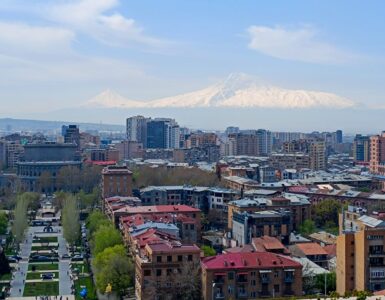
Mount Ararat (5,137 metres, with the smaller Sis/Little Ararat at 3,896 metres beside it) has been the symbol of Armenia for centuries — it appears on the Armenian coat of arms, on the Ararat brandy label, and in the consciousness of every Armenian worldwide. It is technically in Turkey, transferred as part of the 1921 Treaty of Kars between Soviet Russia and Turkey. Armenians consider this one of the defining historical injustices.
From Khor Virap on a clear morning, Ararat is approximately 32 km away. At this distance, the mountain is enormous — the summit is 5,137 metres above sea level but the base rises from a plain at roughly 800 metres, giving a visible relief of over 4,300 metres. No photograph conveys the scale accurately.
When can you see Ararat?
Ararat is most clearly visible in the early morning before atmospheric haze builds — typically before 10am in summer. In July the plain heats up quickly and haze can obscure the upper summit by midday. The clearest conditions are in the cooler months (October–April) when the air is drier and the summit snow is most extensive. Winter mornings — particularly after overnight rain — can produce extraordinary clarity.
| Time of day | Ararat visibility in July | Notes |
|---|---|---|
| Dawn – 9am | Excellent | Best light, clearest air, fewest visitors |
| 9am – 11am | Good | Still clear, tour groups arriving |
| 11am – 2pm | Moderate | Haze building, busy, midday heat |
| 2pm – 5pm | Often hazy | Worst time in July |
| 5pm – sunset | Improving | Warm light, evening tours arrive |
| Sunset | Good – excellent | Pink light on snow summit — best photography |
Photography tip
The best light for photographing Khor Virap with Ararat is either dawn (soft golden light on the monastery, snow catching the early sun) or sunset (pink and amber light on both the monastery and the mountain). The midday shot — overlit, hazy — is the one that fills most tourist cameras. Go early or stay late.
Best Time to Visit Khor Virap
Khor Virap is open year-round and worth visiting in every season — the experience changes significantly by time of year:
Winter (December–February): The best months for Ararat visibility. Snow on the Ararat plain below the monastery is rare but possible; the summit snow is at its most extensive. Almost no tourists. The cold is real but bearable for a 45-minute visit. The light on clear winter mornings is extraordinary.
Visiting Armenia in winter?
Winter is the best season for Ararat clarity — and Yerevan hotels are at their lowest prices. Get an eSIM before you arrive and book your base well ahead of the holiday period.
Spring (April–May): The apricot trees on the Ararat plain blossom in mid-April — the pink-white blossom covering the plain with Ararat behind it is one of the most beautiful natural events in Armenia. Warm but not hot, moderate crowds. Excellent for photography.
Summer (June–August): Hot on the plain (35–40°C in July). Ararat becomes hazy by late morning. Go at dawn or at sunset. Very busy with tour groups from late morning. Despite the heat and crowds, still worth it — the scale of Ararat is impressive in any conditions.
Autumn (September–October): Good visibility, cooler temperatures, the plain turning gold. Second best season after winter for clarity. Comfortable for visiting at any time of day.
Best Combination Routes from Khor Virap
Khor Virap alone takes 45–60 minutes. Almost every visitor combines it with other southern Armenia destinations — the road south continues through some of the best scenery in the country.
★ Most popular — full south day
Khor Virap + Noravank + Areni Wine
Yerevan → Khor Virap (30km) → Noravank (120km) → Areni (110km) → Yerevan (120km)The classic southern Armenia day trip. Khor Virap in the morning, Noravank red-rock canyon in the early afternoon, Areni wine tasting before heading back. Covers the three best non-monastery sights south of Yerevan in one long day.
Best extended south
Khor Virap + Noravank + Jermuk + Wine
Full day south — adds Jermuk spa resortAdds the Jermuk spa and waterfall to the standard Khor Virap + Noravank route. Jermuk sits in a mountain valley with a famous mineral spring waterfall — a genuinely beautiful detour for those who have time.
Best Khor Virap + Garni/Geghard
Khor Virap + Garni + Geghard
South then east — covers two opposite directionsAn unusual combination that covers the two most iconic day trips from Yerevan in one long day — Khor Virap south of the city, then Garni and Geghard in the Azat gorge to the east. Requires an early start and efficient timing but is entirely possible.
Best ultimate south route
Khor Virap → Tatev (full south Armenia)
Yerevan → Khor Virap → Noravank → Tatev → Goris (overnight)The full southern Armenia route in two days. Khor Virap and Noravank on day one, overnight in Goris, Tatev cable car and Khndzoresk on day two. The most complete south Armenia itinerary available.
Tours from Yerevan to Khor Virap
Khor Virap is easily reached by private car or taxi from Yerevan, but organised tours are the most practical option for visitors who want to combine it with Noravank and Areni — the roads between these sites are not well-served by public transport.
Best standalone visit
Khor Virap Day Trip from Yerevan
A focused Khor Virap trip for visitors who specifically want the monastery and Ararat view without additional stops. Good for those who have already seen Noravank or who have limited time.
From ~$20–35/person
★ Best classic south combo
Khor Virap, Areni & Noravank Private Tour
The most popular southern Armenia private tour — Khor Virap, Areni wine cave and tasting, Noravank red canyon. Covers the three essential south Armenia sights in one well-paced day. Private format gives flexibility on timing.
From ~$45–70/person
Best with wine + caves
Khor Virap, Noravank, Birds’ Cave & Wine
Adds the Birds’ Cave (Hnaberd) — a prehistoric cave with bones of ancient birds — to the standard Khor Virap + Noravank route. A more unusual itinerary for visitors who want something beyond the standard highlights.
From ~$40–60/person
Best with Jermuk spa
Khor Virap, Noravank, Jermuk & Wine
Extends the southern Armenia route to include Jermuk — the mountain spa resort with a mineral waterfall. A longer day (10–11 hours) but covers more of the south than any other single-day tour.
From ~$45–70/person
Best Khor Virap + east combo
Khor Virap + Garni & Geghard
Combines the two most iconic day trips from Yerevan — Khor Virap south and Garni/Geghard east. A long day that covers the most-photographed views in Armenia: Ararat from Khor Virap, cave monastery at Geghard.
From ~$40–65/person
Best full south Armenia
Khor Virap → Tatev (South Armenia in 2 days)
The most complete southern Armenia route — Khor Virap and Noravank on day one, Tatev cable car and Khndzoresk on day two. The right format for visitors with two days to spare and a desire to see all of the south.
From ~$80–120/person (2 days)
Best self-drive
Rent a Car — Drive Yourself
Khor Virap is 30 km south on a fully paved road, straightforward to reach independently. A rental car lets you arrive at dawn before any tour group, stay as long as you want, and continue south to Noravank and Areni at your own pace.
From ~$38/day
Getting to Khor Virap from Yerevan
By car or taxi: The most practical option. From central Yerevan, take the road south towards Artashat, then follow signs for Khor Virap. Total 30 km, 35–45 minutes. Parking at the site is free. A one-way taxi from Yerevan costs AMD 4,000–6,000 ($10.25–15.40) by app; agree return pickup time before the driver leaves.
By marshrutka (budget option): Take a marshrutka from Yerevan’s Gortsaranain bus station towards Artashat. Get off at the Pokr Vedi turn-off (ask the driver) and walk or hitch the remaining 3 km to Khor Virap. The return is less predictable — confirm timing before committing to this option.
By organised tour: The easiest option for combining Khor Virap with Noravank and Areni — all transport handled, no navigation required.
Practical Information
Entry: Free. The monastery complex is open daily. The underground pit (Khor Virap itself) is open for visitors — take the steep iron ladder. Not recommended for those with mobility issues or severe claustrophobia.
Dress code: Modest dress required — shoulders and knees covered. Scarves available at the entrance for women. Respectful behaviour inside the active church.
Time needed: 45–60 minutes for the monastery complex and viewpoint. Add 15–20 minutes if descending into the pit. Add 30 minutes if you want to walk around the hill for different angles of Ararat.
Facilities: Small shop selling candles and souvenirs. No café on site — bring water, especially in July when temperatures on the plain reach 35–40°C. A roadside restaurant 500m from the entrance has basic Armenian food.
Photography: No restrictions. Tripods permitted. The best positions for Ararat are from the hilltop terrace on the north side of the monastery (facing north towards the city with Ararat behind the church) and from the approach road looking south.
July heat warning
The Ararat plain in July reaches 35–40°C by midday. The monastery site has very limited shade. Bring water, wear a hat, and plan your visit for early morning (before 10am) or late afternoon (after 5pm). The heat is manageable for a 45-minute visit but unpleasant for longer.
Where to stay: Khor Virap is a day trip destination — almost no one stays overnight nearby. Base yourself in Yerevan and travel out for the day. See our Where to Stay in Yerevan guide for hotel recommendations across all budgets.
More Armenia Guides
- Armenia Travel Guide 2026 — complete overview
- Yerevan Travel Guide 2026 — your base
- Where to Stay in Yerevan
- Garni & Geghard from Yerevan — best combo with Khor Virap
- Tatev Monastery Guide — the full south continuation
- Lake Sevan Guide
- Best Things To Do in Armenia
- Armenia Travel Costs 2026
- Is Armenia Safe? 2026
- Best Time to Visit Armenia
- Georgia Travel Guide 2026 — the neighbouring country
Frequently Asked Questions — Khor Virap
Can you go inside Khor Virap monastery?
Yes. Khor Virap Monastery is open to visitors daily and entry is free. You can walk through the monastery complex, enter the main church of Surb Astvatsatsin, and descend into the underground pit — the original “deep dungeon” where Gregory the Illuminator was imprisoned — via a steep iron ladder. The pit is approximately 6 metres deep and accessible to most visitors. Modest dress is required inside the churches.
How much time do you need at Khor Virap?
45–60 minutes is enough for most visitors — the monastery complex, the hilltop viewpoint, and the underground pit. Add 15–20 minutes if you want to walk around the hill for different angles of Ararat. Add 30 minutes if you are a photographer wanting to work the light. Most organised tours allow 60–75 minutes at the site.
Can you visit Khor Virap without a tour?
Yes, easily. Khor Virap Monastery is 30 km from Yerevan on a straight, well-signed road. You can drive yourself (rent a car or take an app taxi — AMD 4,000–6,000/$10.25–15.40 one way), arrange a private driver through your hotel, or take a marshrutka towards Artashat and get off at the Pokr Vedi turn-off. A tour makes sense if you want to combine Khor Virap with Noravank and Areni in one day without navigating the routes yourself.
How far is Khor Virap from Yerevan?
Khor Virap is 30 km south of Yerevan — about 35–45 minutes by car. It is the closest major Armenian monastery to the capital and works as a half-day trip, usually combined with Noravank canyon and Areni wine tasting for a full day.
Can you see Mount Ararat from Khor Virap?
Yes — Ararat is approximately 32 km from Khor Virap and dominates the view to the southwest. Visibility is best in the early morning (before 10am) and in the cooler months (October–April). In July, atmospheric haze can reduce visibility by midday. On a clear morning the mountain is spectacular — the full 5,137-metre cone, snow-capped year-round, fills the sky behind the monastery.
Is Khor Virap worth visiting?
Yes. The combination of the 17th-century monastery and Mount Ararat is one of the most striking views in the Caucasus. It takes 45–60 minutes and is only 30 km from Yerevan. Even visitors who are not interested in history or religion tend to find it impressive. Best combined with Noravank canyon for a full southern Armenia day.
What is the history of Khor Virap?
Khor Virap — “Deep Dungeon” in Armenian — is where Gregory the Illuminator was imprisoned for 13 years by King Tiridates III for refusing to renounce Christianity. After his release, Gregory converted the king and Armenia became the first nation to adopt Christianity as its state religion in 301 AD. The underground pit is still accessible to visitors. The current monastery buildings date mainly from the 17th century.
What is the best time to visit Khor Virap?
Early morning (before 10am) for the clearest Ararat views and fewest visitors. Winter (December–February) for the best visibility and the most extensive snow on Ararat. April for the apricot blossom on the Ararat plain. Avoid midday in July–August when the plain temperature reaches 35–40°C and haze reduces Ararat visibility.
Why is Ararat in Turkey if it is Armenia’s symbol?
Mount Ararat was part of the Armenian Highlands and has been the symbol of Armenia for centuries. Following World War I and the Armenian Genocide, the 1921 Treaty of Kars between Soviet Russia and Turkey assigned the mountain to Turkey as part of border negotiations. For Armenians, this represents one of the defining historical injustices — the national symbol is visible from the capital but belongs to a neighbouring country with which relations remain severed.
Ready to Visit Khor Virap?
Go early for the best Ararat views. Combine with Noravank and Areni for the perfect southern Armenia day.
This article contains affiliate links. If you book through them, CaucasusExpert.com earns a small commission at no extra cost to you. All recommendations are based on personal experience and honest assessment. Full disclosure policy.